
Markets ended lower on Thursday following the expiry of July derivative contracts weighed down by profit taking in FMCG shares after recent gains.
Firms denied peer review certificate may be barred from auditing

The Bombay Stock Exchange's 30-share Sensex closed at 19,504 up 117 points. The National Stock Exchange's 50-share S&P CNX Nifty closed up 26 points at 5,930.

The Nifty rose by 32.40 points to 6,135.85, after touching the day's high of 6,187.75.

The domestic equity markets are expected to extend gains following the strong showing of the Narendra Modi-led Bharatiya Janata Party (BJP) in the state elections - a crucial precursor to the general elections in May. The BJP decisively secured victories in three of the four key states - Madhya Pradesh, Rajasthan, and Chhattisgarh. While the battles in these three states were closely contested, the scale of the BJP's triumph has surprised many, heightening expectations for regime continuity in 2024 - a positive catalyst for the markets.

Despite the possibility of the economy bottoming out, the investment cycle could remain weak for another couple of years and earnings downgrades should continue.
Government is set to release CPI for the month of May and Index of Industrial Production IIP for the month of April today.

BSE- mid-cap & small-cap outperformed benchmark indices

Following the sharp run in markets, valuations across the board have become elevated. The National Stock Exchange Nifty50 Index now trades at a 12-month trailing price-to-earnings (P/E) multiple of 24.3 times, 18 per cent higher than this year's low of 20.5 times. The valuation expansion in the broader markets has been sharper.

Wall Street-correlated stock markets are facing the risk of correction, as Christopher Wood, the global head of equity strategy at Jefferies, conveys to investors in his latest edition of GREED & fear. Rising crude oil prices, which are nearing $100 a barrel (Brent), pose a threat to the global central bank's battle against inflation and have led to a re-evaluation of its exposure to Indian stocks. "The potential for more US Federal Reserve (Fed) rate hikes, combined with the risk that monetary tightening finally bites as regards the economy, remains a risk for Wall Street-correlated world stock markets. "There is also the oil factor. This is why GREED & fear continues to believe the pain trade is down. "Areas in Asia, such as Indian midcaps, which have already done very well, are at obvious risk of some profit-taking," writes Wood.
The Sensex ends up 16 points to end at 20,514.

BSE-IT, capital goods, banks, real-estate led gains.
The Bombay Stock Exchange's 30-share Sensex closed at 18,401 up 405 points. The National Stock Exchange's 50-share S&P CNX Nifty closed at 5,409 up 124 points.

ICICI Bank, Axis Bank, Infosys, M&M, Tech Mahindra, Tata Steel, SBI and Maruti were also among the gainers. On the other hand, IndusInd, TCS, Titan and Asian Paints declined.
The country's two ubiquitous financial powerhouses, HDFC and ICICI Bank, have been the darling of participatory notes, the instrument through which overseas investors invest indirectly - through foreign institutional investors - in India's stock market. Among the stocks comprising Bombay Stock Exchange's Sensitive Index and National Stock Exchange's S&P Nifty, HDFC has the highest P-Notes holding in value, 14.2 per cent, followed by ICICI Bank's 9.1 per cent.

BSE Metal, IT and Consumer Durable indices surged by nearly 2% each. However, BSE FMCG index declined by nearly 1%.

Without naming Adani group specifically, the capital markets watchdog said in a statement that unusual price movement in the stocks of a business conglomerate has been observed in the past week.
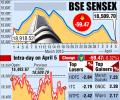
BSE-FMCG, consumer durables, pharmaceuticals led declines.

BSE-real-estate, bankex, auto lead gains on BSE.

Benchmark share indices ended nearly 2% down on Monday, amid weak cues from Asia and Europe, with index heavyweight Infosys leading the decline

Markets continued to trade on a volatile note in afternoon deals, ahead of the futures and options expiry on Thursday. The Sensex is up32 points at 16,999. Nifty is up five points at 5,146.

Fund managers of large-cap and equity-linked saving schemes (ELSS) have demonstrated a marked improvement in their performance over the past year, according to the latest SPIVA (S&P Indices Versus Active) report released by S&P Dow Jones Indices. In the one-year period ending June 2023, 17 per cent of active large-cap schemes outperformed the S&P BSE 100, compared to just 9 per cent at the end of June 2022. In the case of ELSS, there was a sharp improvement in performance, with 66 per cent of active schemes delivering better returns than the benchmark S&P BSE 200.
The Bombay Stock Exchange benchmark Sensex sank by 951 points on black Monday on panic selling by funds, triggered by weak global cues.

Rakesh Jhunjhunwala sounded another note of caution on the nature of the latest bull run.

The net inflows into active equity mutual fund (MF) schemes registered more than a twofold month-on-month rise in August, crossing Rs 20,000 crore, the highest in five months. This rise in net inflows was boosted by an 18 per cent growth in gross investments, driven by a record Rs 15,800 crore inflow through the systematic investment plan (SIP) route and Rs 5,000 crore collected by seven new fund offers (NFOs) in the active equity space, reveals data released by the Association of Mutual Funds in India (Amfi). Moreover, redemptions moderated in August, declining by 19 per cent to Rs 24,580 crore, after staying elevated in the previous three months owing to profit booking.

Sensex zooms 200 points in Muhurat trading, Nifty regains 7,800.

While Nifty 50 reflects changes in 40 years, it also shows what is missing: Low-cost manufacturers at one end, and deep-value players at the other. Also missing are technology players, observes T N Ninan.

National Stock Exchange index Nifty shot up 50 points to 4,756.45.

sustained inflow of foreign funds kept the market in a cheerful mood.

Rise in investor sentiment, return of risk appetite aid shares across the board

Government-owned companies are more generous in rewarding their shareholders with dividends.
On the last day of Satyam's stint in India's benchmark indices - the Bombay Stock Exchange Sensex and the National Stock Exchange S&P CNX Nifty - its shares turned out to be a punter's delight.
The Sensex traded lower by 536.19 points at 15,240.12 at noon with most heavy-weight stocks plunging to recent lows. Similarly, the second wide-based National Stock Exchange index Nifty dropped by 173.10 points at 4446.70.

'Trading is about psychology; 75% of it is about keeping your emotions in check.'

23 Nifty companies reported an annual decline in net profit.

The National Stock Exchange index Nifty gained 3.75 points at 4,572.30. It touched the day's high of 4,596.75 and a low of 4,528.50 points. Among the 30 Sensex stocks, 14 closed with losses while 16 gained. Overseas funds bought stocks of a net $146.6 million on July 23, taking total investments in equities this year to $6.57 billion.

Over 60 companies are ready to launch IPOs in the coming months.

Stocks of small- and mid-cap companies continued to gain ground in July, notwithstanding analysts sounding caution on these two market segments given the sharp run thus far in calendar year 2023 (CY23). Sanjeev Prasad, co-head of Kotak Institutional Equities, in a note co-authored with Anindya Bhowmik and Sunita Baldawa in June-end, had cautioned against the sharp run in small- and mid-caps. "We do not see any particular reason for the excitement in small- and mid-cap stocks.

Retail investors now own a bigger slice of small-cap companies than a couple of years earlier, attributable to their growing conviction in mutual fund (MF) schemes focused on this space. Data from Capitaline shows MFs' average holding in the National Stock Exchange Nifty Smallcap 250 rising to 8.67 per cent, from 7.67 per cent in the past two financial years, with the number of companies with over 20 per cent MF holdings, rising from 15 to 24. At the end of May, the top five small-cap firms with the highest MF holdings were Carborundum Universal, Blue Star, Cyient, Gujarat State Petronet, and Cholamandalam Finance.

Sensex rose 5.8% this year, against a 3.2% rise in Nifty; Axis Bank inclusion may blunt Sensex edge
